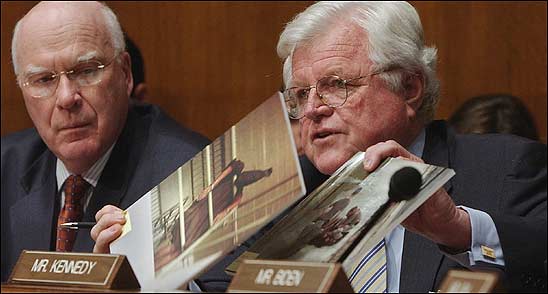
Senators Patrick Leahy of Vermont (left) and Edward M. Kennedy of Massachusetts, displaying photos of abused prisoners, questioned Ashcroft. (AP Photo)
| Senators Patrick Leahy of Vermont (left) and Edward M. Kennedy of Massachusetts, displaying photos of abused prisoners, questioned Ashcroft. (AP Photo) |
WASHINGTON -- Attorney General John D. Ashcroft told Congress yesterday that the Bush administration "rejects torture," but he refused to comment on a series of internal legal memoranda about the treatment of detainees, further fueling speculation that administration policies led to the abuse of prisoners in Iraq and the war on terrorism.
Appearing before the Senate Judiciary Committee, Ashcroft said the memos were the privilege of the executive branch's decision makers, and resisted calls by both Democrats and Republicans to make them public.
"I'm not going to comment on the memos and advice that I give to executive departments of government," Ashcroft told the ranking Democrat, Senator Patrick Leahy of Vermont. Pressed by Senator Edward M. Kennedy of Massachusetts to say whether he would release the memos, Ashcroft shot back, "No, I will not."
The grilling yesterday focused on a March 2003 memo prepared by administration lawyers for Secretary of Defense Donald H. Rumsfeld, obtained by the Globe. It concluded that President Bush was not bound by international and American laws banning torture when approving harsh interrogation techniques and that military officials could be shielded from prosecution if they believed they were acting under orders from superiors.
Lawmakers also scrutinized an August 2002 Justice Department
memo by then-Assistant Attorney General Jay Bybee, prepared at the
request of the CIA, that stated torture "may be justified" under some
circumstances, including if it is used "in order to prevent further
attacks on the United States by the Al Qaeda terrorist network," the
Members of both parties said the memos raise new questions about whether torture is ever justified and that a thorough debate over what constitutes torture is needed. Democrats quickly pounced on the revelations as further evidence that administration policy bred an atmosphere that led to the abuse of prisoners.
"This is what directly results when you have that kind of memoranda out there," Kennedy said.
Ashcroft denied such charges, telling the committee, "That is false. It is an inappropriate conclusion." He said the Bush administration "has operated with respect to all of the laws enacted by the Congress, all of the treaties embraced by the president and the Congress together, and the Constitution of the United States, and no direction or order has been given to violate any of those laws."
Yet the 2003 Pentagon memo argued that in wartime the president's Constitutional powers as commander in chief can trump legal limitations on torture. The document contends that torture could be deemed a "necessity" to glean information about potentially imminent national security threats.
The leaked 56-page memo -- officials said yesterday that dozens of other pages were not released -- also concluded that the Guantanamo Bay, Cuba, detention facility falls outside the jurisdiction of US laws banning torture. And under the Uniformed Code of Military Justice, which does apply to the US base, "legal doctrines could render specific conduct, otherwise criminal, not unlawful," it said.
But not everyone in the Bush administration agreed with the analysis. William Taft, the State Department's lawyer wrote in an appendix that it would weaken the protections of the Geneva Conventions for US troops. Ultimately, the Pentagon adopted a set of 24 interrogation methods it would use at Guantanamo, according to Pentagon officials, the majority of them psychological techniques described in Army field manuals.
Yesterday's hearing quickly became a debate on how to define torture. The committee chairman, Senator Orrin Hatch, Republican of Utah, said "we need more discussion about where and by whom the line should be drawn between permissible aggressive interrogation techniques and when interrogation becomes torture, and whether torture is ever justified."
Others accused the Bush administration of endangering US troops with its policies. "The administration's permissive attitude threatens not only to undercut our moral credibility, but encourage other countries to use torture," Representative Martin T. Meehan, a Lowell Democrat, said in a telephone interview.
Meehan and Representative John Conyers of Michigan, the ranking Democrat on the House Judiciary Committee, sent a letter yesterday to Rumsfeld seeking "a complete explanation of the Department's current official position on the use of torture."
"There's a reason why we sign these treaties," Senator Joseph R. Biden, Democrat of Delaware, reminded Ashcroft at the hearing. "To protect my son in the military. That's why we have these treaties, so when Americans are captured, they are not tortured."
Ashcroft, who also has a son in uniform, told Biden, "I care about your son."
Biden also asked Ashcroft whether he believed torture is justified.
After first declining to discuss "hypotheticals," Ashcroft finally responded, "I condemn torture. I don't think it's productive, let alone justified."
Bryan Bender can be reached at bender@globe.com.