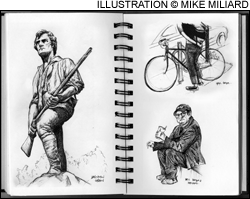
Massachusetts Avenue, 15 miles or so of asphalt, snakes through historic Lexington and suburban Arlington, slices into the urban and intellectual cores of Cambridge and Boston, and peters out in the industrial lots of Roxbury and Dorchester. It wends its way past bars and nightclubs and churches and sex shops and funeral homes and frat houses and warehouses and restaurants and record stores. An old candy factory. A nuclear reactor. If it’s a bit much to call it our Broadway or Sunset Strip, it’s safe to say it’s just as teeming with life and local mythology. In 1978, Willie Alexander captured Mass Ave’s multifarious character in his song of the same name:
Looking lucid, looking juiced, looking jaded, looking faded on Mass Ave,
Looking hairy, looking hip in the mirrors before the Cantab.
Ooh, you might see a cat in a top hat or a wino or a blind man on Mass Ave.
You might see an old friend, or run from a ghost on Mass Ave.
Over the years, I’ve fallen in love with this street. Walking home drunk from the Middle East. Flipping through the $1 jazz bins at Stereo Jack’s or overpriced CDs at the old Tower Records. A cheeseburger at the Friendly Eating Place, the paper and a pint at the Plough & Stars. Waiting (and waiting) for the 77 bus. But even with the intimacy between us, I knew I could stand to know the street better. So I spent two hot summer days walking from Lexington to Dorchester.
WE’VE GOT HISTORY
THE BIRTHPLACE OF AMERICAN LIBERTY, proclaims the sign, perched atop a flagpole stretching dizzyingly toward the clouds.
As good a starting point as any.
It’s 10 am. The early-morning sun shines bright and hot, and Lexington Green seems to glow as two boys, one carrying a wooden sword, the other toting a toy rifle and dressed in a plumed cap, play Minutemen and Red Coats, killing each other over and over as they dart in and out of the shade. Tourists, listening to an old woman in colonial garb, cluster in a group near an engraved stone. On the far side of the park, a mother clasps her crying toddler’s shoulders and screams, "You’re going to spoil the day for everyone!"
On Lexington’s main drag there’s a shoe store (Michelson’s, est. 1919) and a drug store (Theatre Pharmacy, est. 1935), among other establishments right out of Thornton Wilder. And then there’s the caffeine: a Starbucks at 1729 Mass Ave; a Peet’s at 1749 Mass Ave; a Dunkin’ Donuts barely a block away from those. On the sidewalks, pairs of moms push strollers and sip tall iced coffees; a kid in a Ramones shirt on a bike nods hello as he passes. Such a friendly town.
Outside Lexington center, signs of civilization fade away. The air is heavy and humid, smelling of chlorophyll and thrumming with the summer buzz of crickets and cicadas.
Walking this wooded stretch, past roadside taverns, white-stone churches, and clapboard houses more than 300 years old, you get to thinking about history. About the gallant warrior farmers who drove those pernicious Brits from our blood-soaked soil. About what must have happened right here. For a moment, you imagine the air acrid with musket smoke, filled with fife and drum music, the clangor of gunshots and shouting.
On the sandy shoulder of the road, just lying there, is a large white plume. Three feet long. Just like one that might have been dipped in ink by John Hancock or Samuel Adams when they lived in this very town. Why is it here? What huge bird could it have come from? I can’t guess. Very strange. But not the strangest thing I’ll see on this trip.
MAIN STREET, USA
Something to know about Arlington: practically everything that’s not an ethnic restaurant — and those are legion — is old-fashioned. Not colonial old, like when the town was still called Menotomy, but more like a post-war cliché. A Pleasantville: the Brigham’s in Arlington Heights, serving up lime rickeys and orange sherbet. The Capitol Theatre, with its ticket window and wedge-like marquee. Stately Arlington High School, which looks as though crew-cut lettermen and ponytailed bobbysoxers should still be flirting with each other out front. The place even has a store that services typewriters.
It must be comforting to the legions of old folks who call the town home. Shivering in the arctic air conditioning of Johnny’s Foodmaster, I watch a man who looks like Jimmy Cagney arrange lemons and limes just so as dawdling seniors in golf shirts and polyester pants push lightly laden shopping carts. At the Regent Theatre in Arlington Center, a poster advertises that Mickey Rooney will be stopping by for three nights in September. "Let’s Put on a Show!"
It can make for some interesting juxtapositions. Not far from the Lexington border, an old woman sits silently on the porch of Sunrise Assisted Living, staring silently at idling traffic. A Virgin Mary statuette in the window to her left does the same. A souped-up car passes slowly by them both, hardcore punk blaring from within.
Yuppies live here, too, and Arlington Center is a mecca for out-of-town foodies. On the Ave, between Lexington and Cambridge, I count at least four Chinese restaurants (Jade Garden ... Tiki In ... Shanghai Village ... Great Wok), at least four Thai restaurants (Rama Thai ... Thai Moon ... Sweet Chili ... Thailand Café), at least two Indian restaurants (Punjab ... Bangalore Café), and one all-purpose Japanese-Korean-Thai restaurant (Asiana). And that’s not counting the innumerable Italian and Greek restaurants that form the bedrock of the commercial landscape.
Arlington is, after all, all-American — in all the new and old ways. It’s the birthplace of Samuel Wilson, the supposed progenitor of Uncle Sam. And if it’s got an unusual share of blue-hairs, that’s probably because the elderly have always done well here. Near the Uncle Sam statue at the center of town, there’s a plaque:
NEAR THIS SPOT SAMUEL WHITTEMORE, THEN 80 YEARS OLD,
KILLED THREE BRITISH SOLDIERS APRIL 19, 1775.
HE WAS SHOT, BAYONETED, BEATEN AND LEFT FOR DEAD, BUT
RECOVERED AND LIVED TO BE 98 YEARS OF AGE.
Not far away, there’s another memorial on a stone in front of a building:
HERE STOOD COOPER’S TAVERN, IN WHICH
JABEZ WYMAN AND JASON WINSHIP
WERE KILLED BY THE BRITISH, APRIL 19, 1775.
It’s now a Starbucks.
STRANGE INTERLUDE
Immediately beyond Alewife Brook Parkway (which marks the Arlington/Cambridge border) lies a sort of no man’s land, populated by little more than steady traffic and a few businesses with no-nonsense names — Jack’s Gas, Fast Phil’s Haircuts — that sound like they belong in a cartoon. Maybe it’s the heat or the dehydration, but after I’ve walked for almost three hours, the vibe on the street gets strange.
A blind woman with blond ringlets and orange sunglasses, walking the opposite direction, stops me on the sidewalk. She asks where she can find a Bank of America farther up the road. I’m nonplussed. It occurs to me that I’ve passed probably half a dozen Bank of Americas so far, but can’t recall precisely where any of them are. When I tell her I can’t help her, she seems angry with me.
Inside Kaleidoscope Tattoo & Art Gallery, hangs an enormous painting of jowly Joe Friday from Dragnet, standing in some psychedelic dreamscape. There’s also a towering 10-foot crucifix, cobbled together from car parts. While I gaze upon Christ’s forlorn-and-shiny face, Bronson Arroyo and Johnny Damon sing "Dirty Water" on the radio. I decide to leave.
SUNBATHERS AND HOBOS
"North Cambridge grew gradually along Massachusetts Avenue," reads a tourist information sign near the Harvard campus. "For years it was a livestock center and the Porter House Hotel flourished in Porter Square, leaving its name to us on a fine cut of beefsteak."
I already knew that.
I lived here for three years, and have walked the stretch of Mass Ave between here and Central Square countless times. Porter Square’s strip-mall charm feels like home. From the window of Koreana restaurant, a mother and her baby even wave to me as I pass.
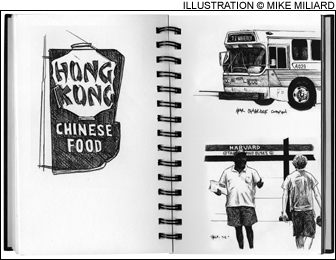
Farther up the road, an MBTA tram idles near Cambridge Common while sunbathers and hobos alike splay indolently on the grass. A black-and-white dog on a leash suddenly and inexplicably lies down in the middle of Mass Ave as traffic approaches. Time slows for a moment as her owner, mildly panicked, drags her across the road.
Above the stone archway marking the ingress to Harvard Yard is a chiseled inscription: ENTER TO GROW IN WISDOM. So I do. On the oak-shaded lawn, hundreds of people mill about, pointing, looking at maps, posing for photos next to the John Harvard statue.
Overrun by bland chain stores and the bland people who patronize them, Harvard Square may be a sterilized shell of what it used to be, but it still has its characters. In front of Au Bon Pain is the man-mountain African-American who’s been selling Spare Change there for years. If you’ve been to Harvard Square, you know him. He’s said hello to you — "Ma’aaaaaam!" "Hellooooooo, sir!" — in that singsong voice that seems vaguely mocking. He twirls in slow circles as if to music only he can hear. Meanwhile, the people he says hi to walk right past, their expressions — amused, determinedly neutral, openly annoyed, mildly chagrined — acting as windows to their souls.
Near the Pit, where teens skateboard and assorted other characters loiter fecklessly, sits a woman whose matted hair is one single, enormous dreadlock, as thick as her torso and nearly as long as she is tall. Meanwhile, a severe-looking woman of indeterminate age with cropped hair and a pinched face sits at a small table near the subway. "Animal rights! Sign the petition," she screams at no one, without looking up. "Animal abuse!"
She’s probably unaware of the man sitting kitty-corner from Leavitt & Pierce tobacco shop. His cardboard sign says he’s homeless. Next to him, a dog and a cat lie limply on a fully loaded shopping cart. In this oppressive heat, both animals look dead — the cat rests its head on a pewter bowl, its tongue protruding limply — and their owner doesn’t look much better off.
FRANCHISE CREEP
I pass through the Furniture Ghetto, as the stretch between Harvard and Central Squares is sometimes called, and walk down a set of street-level stairs and into Looney Tunes records. Mission of Burma drummer Peter Prescott is behind the cash register. (He works there when he’s not touring or recording.) A copy of this very paper spread out before him, he chuckles a little as he glances backward toward the Mass Ave sidewalk above.
"I don’t wanna be the old fart that says, ‘Geez, it used to be cooler,’" he says of Mass Ave. "But y’know, it kinda was."
If the street is still a stage for life’s rich pageant, franchise creep has also taken its toll. Sure, it’s got character — just not as much as it used to. Prescott remembers the old days, when he could walk home from his Newbury Street record store, up Mass Ave, and stop to paw through vinyl stacks at other record stores every few blocks along the way.
"It was definitely the central artery that ran through both towns before," he says. "But now it’s just ... there."
Cool stores like Looney Tunes "can’t really exist on this street anymore," he says. Rents are too high, gentrification too entrenched. Looney Tunes only barely scrapes by every month. Mass Ave used to be different, "used to have more impact. Used to be more impressive to me. I can’t imagine a kid who came here the first year for school would have any affinity for it. It’s just a street now. It’s just a place."
A couple blocks away, Mike White is feeding the sparrows that are hopping around the fenced-in lawn of a residence wedged back between stores. "I try not to feed the pigeons," he says as a pigeon pecks a crumb.
White owns Mojo Music, next door. He’s worked in five record stores in the area over the years. He’s also worked at Oona’s, the secondhand-clothing store that’s been on the corner of Mass Ave and Bow Street for 33 years (his sister owns it). Whether working retail or gigging around as a musician, much of White’s life has been spent "up and down the Ave."
But, he says, "it has changed a lot." He thinks back on the clubs he used to play on and near the Ave. Jonathan Swift’s. Jack’s. The Oxford Ale House. All gone. Mojo may be gone soon, too. "My lease is up in March, told [the landlord] if I couldn’t get the rent less, I’d have to close. Business has slowed down, and I’m not making any money."
Just down the street is the Plough & Stars, which opened in 1969 and closed indefinitely "for renovation" just weeks ago. When — or if — it will reopen is anyone’s guess. Lately, the Plough’s cadre of long-time regulars has been gathering instead at the nearby People’s Republik. They aren’t there today.
MENTAL SQUARE
On the grass in front of Cambridge City Hall, a woman sits Indian-style, reading. A man sleeps, his face to the sky. They’re oblivious to the tumult of nearby Central Square.
Ah, Mental Square. Loud with crowds, jostling and hustling and yelling and laughing. Pungent with sun-cooked trash and exhaust and stale urine. It’s great.
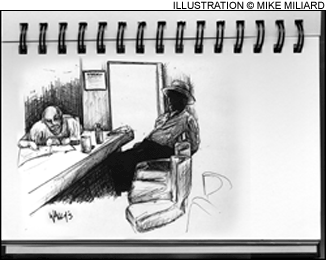
I duck into Cantab Lounge to get out of the sun. This afternoon, it’s cool and dark, and largely quiet. A painting of a woman, turning away, a towel draped just so to reveal the small of her back (and a little more) hangs above the bar. A clock’s swinging pendulum ticks away the minutes.
A gin and tonic, stiff, is $3.75.
Grizzled guys with smoker’s coughs sip mugs of beer, staring at reruns of Walker, Texas Ranger on a corner TV. When a commercial comes on, they keep their eyes on the screen, but it’s hard to tell if they’re staring at it or off into space.
Snatches of conversation suggest hard-bitten lives.
"Yeah, he’s a troubled guy," says the man next to me. "He’s got some good things going on inside ..."
"But his anger," says his lady friend. "You gotta get rid of the anger."
Every couple minutes, a patron ducks out into the late-afternoon glare to smoke and watch the traffic pass by.
Outside, I meet a guy named Gary. He’s got a Colombian red-tailed boa constrictor wrapped around his waist like a belt.
"Usually she’s around my neck," he says. "She loves this heat. You can touch her if you want."
STRANGE INTERLUDE
Immediately beyond Alewife Brook Parkway (which marks the Arlington/Cambridge border) lies a sort of no man’s land, populated by little more than steady traffic and a few businesses with no-nonsense names — Jack’s Gas, Fast Phil’s Haircuts — that sound like they belong in a cartoon. Maybe it’s the heat or the dehydration, but after I’ve walked for almost three hours, the vibe on the street gets strange.
A blind woman with blond ringlets and orange sunglasses, walking the opposite direction, stops me on the sidewalk. She asks where she can find a Bank of America farther up the road. I’m nonplussed. It occurs to me that I’ve passed probably half a dozen Bank of Americas so far, but can’t recall precisely where any of them are. When I tell her I can’t help her, she seems angry with me.
Inside Kaleidoscope Tattoo & Art Gallery, hangs an enormous painting of jowly Joe Friday from Dragnet, standing in some psychedelic dreamscape. There’s also a towering 10-foot crucifix, cobbled together from car parts. While I gaze upon Christ’s forlorn-and-shiny face, Bronson Arroyo and Johnny Damon sing "Dirty Water" on the radio. I decide to leave.
SUNBATHERS AND HOBOS
"North Cambridge grew gradually along Massachusetts Avenue," reads a tourist information sign near the Harvard campus. "For years it was a livestock center and the Porter House Hotel flourished in Porter Square, leaving its name to us on a fine cut of beefsteak."
I already knew that.
I lived here for three years, and have walked the stretch of Mass Ave between here and Central Square countless times. Porter Square’s strip-mall charm feels like home. From the window of Koreana restaurant, a mother and her baby even wave to me as I pass.
Farther up the road, an MBTA tram idles near Cambridge Common while sunbathers and hobos alike splay indolently on the grass. A black-and-white dog on a leash suddenly and inexplicably lies down in the middle of Mass Ave as traffic approaches. Time slows for a moment as her owner, mildly panicked, drags her across the road.
Above the stone archway marking the ingress to Harvard Yard is a chiseled inscription: ENTER TO GROW IN WISDOM. So I do. On the oak-shaded lawn, hundreds of people mill about, pointing, looking at maps, posing for photos next to the John Harvard statue.
Overrun by bland chain stores and the bland people who patronize them, Harvard Square may be a sterilized shell of what it used to be, but it still has its characters. In front of Au Bon Pain is the man-mountain African-American who’s been selling Spare Change there for years. If you’ve been to Harvard Square, you know him. He’s said hello to you — "Ma’aaaaaam!" "Hellooooooo, sir!" — in that singsong voice that seems vaguely mocking. He twirls in slow circles as if to music only he can hear. Meanwhile, the people he says hi to walk right past, their expressions — amused, determinedly neutral, openly annoyed, mildly chagrined — acting as windows to their souls.
Near the Pit, where teens skateboard and assorted other characters loiter fecklessly, sits a woman whose matted hair is one single, enormous dreadlock, as thick as her torso and nearly as long as she is tall. Meanwhile, a severe-looking woman of indeterminate age with cropped hair and a pinched face sits at a small table near the subway. "Animal rights! Sign the petition," she screams at no one, without looking up. "Animal abuse!"
She’s probably unaware of the man sitting kitty-corner from Leavitt & Pierce tobacco shop. His cardboard sign says he’s homeless. Next to him, a dog and a cat lie limply on a fully loaded shopping cart. In this oppressive heat, both animals look dead — the cat rests its head on a pewter bowl, its tongue protruding limply — and their owner doesn’t look much better off.
FRANCHISE CREEP
I pass through the Furniture Ghetto, as the stretch between Harvard and Central Squares is sometimes called, and walk down a set of street-level stairs and into Looney Tunes records. Mission of Burma drummer Peter Prescott is behind the cash register. (He works there when he’s not touring or recording.) A copy of this very paper spread out before him, he chuckles a little as he glances backward toward the Mass Ave sidewalk above.
"I don’t wanna be the old fart that says, ‘Geez, it used to be cooler,’" he says of Mass Ave. "But y’know, it kinda was."
If the street is still a stage for life’s rich pageant, franchise creep has also taken its toll. Sure, it’s got character — just not as much as it used to. Prescott remembers the old days, when he could walk home from his Newbury Street record store, up Mass Ave, and stop to paw through vinyl stacks at other record stores every few blocks along the way.
"It was definitely the central artery that ran through both towns before," he says. "But now it’s just ... there."
Cool stores like Looney Tunes "can’t really exist on this street anymore," he says. Rents are too high, gentrification too entrenched. Looney Tunes only barely scrapes by every month. Mass Ave used to be different, "used to have more impact. Used to be more impressive to me. I can’t imagine a kid who came here the first year for school would have any affinity for it. It’s just a street now. It’s just a place."
A couple blocks away, Mike White is feeding the sparrows that are hopping around the fenced-in lawn of a residence wedged back between stores. "I try not to feed the pigeons," he says as a pigeon pecks a crumb.
White owns Mojo Music, next door. He’s worked in five record stores in the area over the years. He’s also worked at Oona’s, the secondhand-clothing store that’s been on the corner of Mass Ave and Bow Street for 33 years (his sister owns it). Whether working retail or gigging around as a musician, much of White’s life has been spent "up and down the Ave."
But, he says, "it has changed a lot." He thinks back on the clubs he used to play on and near the Ave. Jonathan Swift’s. Jack’s. The Oxford Ale House. All gone. Mojo may be gone soon, too. "My lease is up in March, told [the landlord] if I couldn’t get the rent less, I’d have to close. Business has slowed down, and I’m not making any money."
STRANGE INTERLUDE
Immediately beyond Alewife Brook Parkway (which marks the Arlington/Cambridge border) lies a sort of no man’s land, populated by little more than steady traffic and a few businesses with no-nonsense names — Jack’s Gas, Fast Phil’s Haircuts — that sound like they belong in a cartoon. Maybe it’s the heat or the dehydration, but after I’ve walked for almost three hours, the vibe on the street gets strange.
A blind woman with blond ringlets and orange sunglasses, walking the opposite direction, stops me on the sidewalk. She asks where she can find a Bank of America farther up the road. I’m nonplussed. It occurs to me that I’ve passed probably half a dozen Bank of Americas so far, but can’t recall precisely where any of them are. When I tell her I can’t help her, she seems angry with me.
Inside Kaleidoscope Tattoo & Art Gallery, hangs an enormous painting of jowly Joe Friday from Dragnet, standing in some psychedelic dreamscape. There’s also a towering 10-foot crucifix, cobbled together from car parts. While I gaze upon Christ’s forlorn-and-shiny face, Bronson Arroyo and Johnny Damon sing "Dirty Water" on the radio. I decide to leave.
SUNBATHERS AND HOBOS
"North Cambridge grew gradually along Massachusetts Avenue," reads a tourist information sign near the Harvard campus. "For years it was a livestock center and the Porter House Hotel flourished in Porter Square, leaving its name to us on a fine cut of beefsteak."
I already knew that.
I lived here for three years, and have walked the stretch of Mass Ave between here and Central Square countless times. Porter Square’s strip-mall charm feels like home. From the window of Koreana restaurant, a mother and her baby even wave to me as I pass.
Farther up the road, an MBTA tram idles near Cambridge Common while sunbathers and hobos alike splay indolently on the grass. A black-and-white dog on a leash suddenly and inexplicably lies down in the middle of Mass Ave as traffic approaches. Time slows for a moment as her owner, mildly panicked, drags her across the road.
Above the stone archway marking the ingress to Harvard Yard is a chiseled inscription: ENTER TO GROW IN WISDOM. So I do. On the oak-shaded lawn, hundreds of people mill about, pointing, looking at maps, posing for photos next to the John Harvard statue.
Overrun by bland chain stores and the bland people who patronize them, Harvard Square may be a sterilized shell of what it used to be, but it still has its characters. In front of Au Bon Pain is the man-mountain African-American who’s been selling Spare Change there for years. If you’ve been to Harvard Square, you know him. He’s said hello to you — "Ma’aaaaaam!" "Hellooooooo, sir!" — in that singsong voice that seems vaguely mocking. He twirls in slow circles as if to music only he can hear. Meanwhile, the people he says hi to walk right past, their expressions — amused, determinedly neutral, openly annoyed, mildly chagrined — acting as windows to their souls.
Near the Pit, where teens skateboard and assorted other characters loiter fecklessly, sits a woman whose matted hair is one single, enormous dreadlock, as thick as her torso and nearly as long as she is tall. Meanwhile, a severe-looking woman of indeterminate age with cropped hair and a pinched face sits at a small table near the subway. "Animal rights! Sign the petition," she screams at no one, without looking up. "Animal abuse!"
She’s probably unaware of the man sitting kitty-corner from Leavitt & Pierce tobacco shop. His cardboard sign says he’s homeless. Next to him, a dog and a cat lie limply on a fully loaded shopping cart. In this oppressive heat, both animals look dead — the cat rests its head on a pewter bowl, its tongue protruding limply — and their owner doesn’t look much better off.
FRANCHISE CREEP
I pass through the Furniture Ghetto, as the stretch between Harvard and Central Squares is sometimes called, and walk down a set of street-level stairs and into Looney Tunes records. Mission of Burma drummer Peter Prescott is behind the cash register. (He works there when he’s not touring or recording.) A copy of this very paper spread out before him, he chuckles a little as he glances backward toward the Mass Ave sidewalk above.
"I don’t wanna be the old fart that says, ‘Geez, it used to be cooler,’" he says of Mass Ave. "But y’know, it kinda was."
If the street is still a stage for life’s rich pageant, franchise creep has also taken its toll. Sure, it’s got character — just not as much as it used to. Prescott remembers the old days, when he could walk home from his Newbury Street record store, up Mass Ave, and stop to paw through vinyl stacks at other record stores every few blocks along the way.
"It was definitely the central artery that ran through both towns before," he says. "But now it’s just ... there."
Cool stores like Looney Tunes "can’t really exist on this street anymore," he says. Rents are too high, gentrification too entrenched. Looney Tunes only barely scrapes by every month. Mass Ave used to be different, "used to have more impact. Used to be more impressive to me. I can’t imagine a kid who came here the first year for school would have any affinity for it. It’s just a street now. It’s just a place."
A couple blocks away, Mike White is feeding the sparrows that are hopping around the fenced-in lawn of a residence wedged back between stores. "I try not to feed the pigeons," he says as a pigeon pecks a crumb.
White owns Mojo Music, next door. He’s worked in five record stores in the area over the years. He’s also worked at Oona’s, the secondhand-clothing store that’s been on the corner of Mass Ave and Bow Street for 33 years (his sister owns it). Whether working retail or gigging around as a musician, much of White’s life has been spent "up and down the Ave."
But, he says, "it has changed a lot." He thinks back on the clubs he used to play on and near the Ave. Jonathan Swift’s. Jack’s. The Oxford Ale House. All gone. Mojo may be gone soon, too. "My lease is up in March, told [the landlord] if I couldn’t get the rent less, I’d have to close. Business has slowed down, and I’m not making any money."
Just down the street is the Plough & Stars, which opened in 1969 and closed indefinitely "for renovation" just weeks ago. When — or if — it will reopen is anyone’s guess. Lately, the Plough’s cadre of long-time regulars has been gathering instead at the nearby People’s Republik. They aren’t there today.
MENTAL SQUARE
On the grass in front of Cambridge City Hall, a woman sits Indian-style, reading. A man sleeps, his face to the sky. They’re oblivious to the tumult of nearby Central Square.
Ah, Mental Square. Loud with crowds, jostling and hustling and yelling and laughing. Pungent with sun-cooked trash and exhaust and stale urine. It’s great.
I duck into Cantab Lounge to get out of the sun. This afternoon, it’s cool and dark, and largely quiet. A painting of a woman, turning away, a towel draped just so to reveal the small of her back (and a little more) hangs above the bar. A clock’s swinging pendulum ticks away the minutes.
A gin and tonic, stiff, is $3.75.
Grizzled guys with smoker’s coughs sip mugs of beer, staring at reruns of Walker, Texas Ranger on a corner TV. When a commercial comes on, they keep their eyes on the screen, but it’s hard to tell if they’re staring at it or off into space.
Snatches of conversation suggest hard-bitten lives.
"Yeah, he’s a troubled guy," says the man next to me. "He’s got some good things going on inside ..."
"But his anger," says his lady friend. "You gotta get rid of the anger."
Every couple minutes, a patron ducks out into the late-afternoon glare to smoke and watch the traffic pass by.
Outside, I meet a guy named Gary. He’s got a Colombian red-tailed boa constrictor wrapped around his waist like a belt.
"Usually she’s around my neck," he says. "She loves this heat. You can touch her if you want."
Just down the street is the Plough & Stars, which opened in 1969 and closed indefinitely "for renovation" just weeks ago. When — or if — it will reopen is anyone’s guess. Lately, the Plough’s cadre of long-time regulars has been gathering instead at the nearby People’s Republik. They aren’t there today.
MENTAL SQUARE
On the grass in front of Cambridge City Hall, a woman sits Indian-style, reading. A man sleeps, his face to the sky. They’re oblivious to the tumult of nearby Central Square.
Ah, Mental Square. Loud with crowds, jostling and hustling and yelling and laughing. Pungent with sun-cooked trash and exhaust and stale urine. It’s great.
I duck into Cantab Lounge to get out of the sun. This afternoon, it’s cool and dark, and largely quiet. A painting of a woman, turning away, a towel draped just so to reveal the small of her back (and a little more) hangs above the bar. A clock’s swinging pendulum ticks away the minutes.
A gin and tonic, stiff, is $3.75.
Grizzled guys with smoker’s coughs sip mugs of beer, staring at reruns of Walker, Texas Ranger on a corner TV. When a commercial comes on, they keep their eyes on the screen, but it’s hard to tell if they’re staring at it or off into space.
Snatches of conversation suggest hard-bitten lives.
"Yeah, he’s a troubled guy," says the man next to me. "He’s got some good things going on inside ..."
"But his anger," says his lady friend. "You gotta get rid of the anger."
Every couple minutes, a patron ducks out into the late-afternoon glare to smoke and watch the traffic pass by.
Outside, I meet a guy named Gary. He’s got a Colombian red-tailed boa constrictor wrapped around his waist like a belt.
"Usually she’s around my neck," he says. "She loves this heat. You can touch her if you want."
STRANGE INTERLUDE
Immediately beyond Alewife Brook Parkway (which marks the Arlington/Cambridge border) lies a sort of no man’s land, populated by little more than steady traffic and a few businesses with no-nonsense names — Jack’s Gas, Fast Phil’s Haircuts — that sound like they belong in a cartoon. Maybe it’s the heat or the dehydration, but after I’ve walked for almost three hours, the vibe on the street gets strange.
A blind woman with blond ringlets and orange sunglasses, walking the opposite direction, stops me on the sidewalk. She asks where she can find a Bank of America farther up the road. I’m nonplussed. It occurs to me that I’ve passed probably half a dozen Bank of Americas so far, but can’t recall precisely where any of them are. When I tell her I can’t help her, she seems angry with me.
Inside Kaleidoscope Tattoo & Art Gallery, hangs an enormous painting of jowly Joe Friday from Dragnet, standing in some psychedelic dreamscape. There’s also a towering 10-foot crucifix, cobbled together from car parts. While I gaze upon Christ’s forlorn-and-shiny face, Bronson Arroyo and Johnny Damon sing "Dirty Water" on the radio. I decide to leave.
SUNBATHERS AND HOBOS
"North Cambridge grew gradually along Massachusetts Avenue," reads a tourist information sign near the Harvard campus. "For years it was a livestock center and the Porter House Hotel flourished in Porter Square, leaving its name to us on a fine cut of beefsteak."
I already knew that.
I lived here for three years, and have walked the stretch of Mass Ave between here and Central Square countless times. Porter Square’s strip-mall charm feels like home. From the window of Koreana restaurant, a mother and her baby even wave to me as I pass.
Farther up the road, an MBTA tram idles near Cambridge Common while sunbathers and hobos alike splay indolently on the grass. A black-and-white dog on a leash suddenly and inexplicably lies down in the middle of Mass Ave as traffic approaches. Time slows for a moment as her owner, mildly panicked, drags her across the road.
Above the stone archway marking the ingress to Harvard Yard is a chiseled inscription: ENTER TO GROW IN WISDOM. So I do. On the oak-shaded lawn, hundreds of people mill about, pointing, looking at maps, posing for photos next to the John Harvard statue.
Overrun by bland chain stores and the bland people who patronize them, Harvard Square may be a sterilized shell of what it used to be, but it still has its characters. In front of Au Bon Pain is the man-mountain African-American who’s been selling Spare Change there for years. If you’ve been to Harvard Square, you know him. He’s said hello to you — "Ma’aaaaaam!" "Hellooooooo, sir!" — in that singsong voice that seems vaguely mocking. He twirls in slow circles as if to music only he can hear. Meanwhile, the people he says hi to walk right past, their expressions — amused, determinedly neutral, openly annoyed, mildly chagrined — acting as windows to their souls.
Near the Pit, where teens skateboard and assorted other characters loiter fecklessly, sits a woman whose matted hair is one single, enormous dreadlock, as thick as her torso and nearly as long as she is tall. Meanwhile, a severe-looking woman of indeterminate age with cropped hair and a pinched face sits at a small table near the subway. "Animal rights! Sign the petition," she screams at no one, without looking up. "Animal abuse!"
She’s probably unaware of the man sitting kitty-corner from Leavitt & Pierce tobacco shop. His cardboard sign says he’s homeless. Next to him, a dog and a cat lie limply on a fully loaded shopping cart. In this oppressive heat, both animals look dead — the cat rests its head on a pewter bowl, its tongue protruding limply — and their owner doesn’t look much better off.
FRANCHISE CREEP
I pass through the Furniture Ghetto, as the stretch between Harvard and Central Squares is sometimes called, and walk down a set of street-level stairs and into Looney Tunes records. Mission of Burma drummer Peter Prescott is behind the cash register. (He works there when he’s not touring or recording.) A copy of this very paper spread out before him, he chuckles a little as he glances backward toward the Mass Ave sidewalk above.
"I don’t wanna be the old fart that says, ‘Geez, it used to be cooler,’" he says of Mass Ave. "But y’know, it kinda was."
If the street is still a stage for life’s rich pageant, franchise creep has also taken its toll. Sure, it’s got character — just not as much as it used to. Prescott remembers the old days, when he could walk home from his Newbury Street record store, up Mass Ave, and stop to paw through vinyl stacks at other record stores every few blocks along the way.
"It was definitely the central artery that ran through both towns before," he says. "But now it’s just ... there."
Cool stores like Looney Tunes "can’t really exist on this street anymore," he says. Rents are too high, gentrification too entrenched. Looney Tunes only barely scrapes by every month. Mass Ave used to be different, "used to have more impact. Used to be more impressive to me. I can’t imagine a kid who came here the first year for school would have any affinity for it. It’s just a street now. It’s just a place."
A couple blocks away, Mike White is feeding the sparrows that are hopping around the fenced-in lawn of a residence wedged back between stores. "I try not to feed the pigeons," he says as a pigeon pecks a crumb.
White owns Mojo Music, next door. He’s worked in five record stores in the area over the years. He’s also worked at Oona’s, the secondhand-clothing store that’s been on the corner of Mass Ave and Bow Street for 33 years (his sister owns it). Whether working retail or gigging around as a musician, much of White’s life has been spent "up and down the Ave."
But, he says, "it has changed a lot." He thinks back on the clubs he used to play on and near the Ave. Jonathan Swift’s. Jack’s. The Oxford Ale House. All gone. Mojo may be gone soon, too. "My lease is up in March, told [the landlord] if I couldn’t get the rent less, I’d have to close. Business has slowed down, and I’m not making any money."
Just down the street is the Plough & Stars, which opened in 1969 and closed indefinitely "for renovation" just weeks ago. When — or if — it will reopen is anyone’s guess. Lately, the Plough’s cadre of long-time regulars has been gathering instead at the nearby People’s Republik. They aren’t there today.
MENTAL SQUARE
On the grass in front of Cambridge City Hall, a woman sits Indian-style, reading. A man sleeps, his face to the sky. They’re oblivious to the tumult of nearby Central Square.
Ah, Mental Square. Loud with crowds, jostling and hustling and yelling and laughing. Pungent with sun-cooked trash and exhaust and stale urine. It’s great.
I duck into Cantab Lounge to get out of the sun. This afternoon, it’s cool and dark, and largely quiet. A painting of a woman, turning away, a towel draped just so to reveal the small of her back (and a little more) hangs above the bar. A clock’s swinging pendulum ticks away the minutes.
A gin and tonic, stiff, is $3.75.
Grizzled guys with smoker’s coughs sip mugs of beer, staring at reruns of Walker, Texas Ranger on a corner TV. When a commercial comes on, they keep their eyes on the screen, but it’s hard to tell if they’re staring at it or off into space.
Snatches of conversation suggest hard-bitten lives.
"Yeah, he’s a troubled guy," says the man next to me. "He’s got some good things going on inside ..."
"But his anger," says his lady friend. "You gotta get rid of the anger."
Every couple minutes, a patron ducks out into the late-afternoon glare to smoke and watch the traffic pass by.
Outside, I meet a guy named Gary. He’s got a Colombian red-tailed boa constrictor wrapped around his waist like a belt.
"Usually she’s around my neck," he says. "She loves this heat. You can touch her if you want."
TAKE IT TO THE BRIDGE
The smoot. It is a unit of measurement, precisely five feet and seven inches long — the height of former MIT undergrad Oliver R. Smoot, ’62. When young Oliver was pledging the Lambda Chi Alpha fraternity in 1958, his brothers rolled him bodily, head over heels, across the Mass Ave Bridge. (Its proper name is the Harvard Bridge. Partisans call it the MIT Bridge, but we’ll stick with what just about everyone calls it.)
They found that the bridge — nearly 2035 feet to you and me — is precisely 364.4 smoots plus one ear long, and every year Lambda Chi pledges to repaint the smoot markers along the length of the sidewalk. Anyone who says that fraternities are useless, anti-intellectual diversions that only lead college students into lives of drunken debauchery should know that Mr. Smoot took his special status as a unit of measurement seriously, becoming, in his adult life, the chairman of the American National Standards Institute and the president of the International Organization for Standardization.
The river below the bridge is dark and choppy, laced with tiny whitecaps. Joggers trundle by. The wind blows strong. Stopping in the middle of the bridge — on the 182.2-smoot mark — you can take in the city’s full panorama. Cambridgeport behind you. On the right, the Citgo sign and Fenway’s light towers. Allston, too. Back Bay, the Pru, and the Hancock are straight ahead. Panning to the left, the golden gleam of the State House dome. Downtown. East Cambridge. Beyond that, the Tobin and Zakim Bridges, with the Bunker Hill Monument in the distance. And Mass Ave stretches onward.
BRIGHT LIGHTS, BIG CITY
You know you’re in Boston. The buildings are bigger. The architecture more grand. There’s more bustle. It’s a city. There are the majestic residences of the Back Bay Brahmins. There’s the Eliot Hotel, down Comm Ave from Fenway, where Bill "Spaceman" Lee used to drink after nearly every Sox game. ("I believe in 27 ground ball outs on 27 pitches, and let’s get down to the Eliot Lounge," he said.) Across the street from Virgin Records, on a bench beneath an overhang, a man is propositioned by a prostitute.
In front of Berklee, a kid in a Motörhead T-shirt hacks a butt. Nerds with cellos talk animatedly. A hippie with greasy, stick-straight hair strums an unplugged electric guitar. Inside the main building, a saxophone sounds mellifluous jazz scales.
On the sidewalk outside the Hynes Convention Center T stop, two Scientologists sit at a card table. They’re offering a free "Stress Test." They look lonely.
Christian Science seems to have more appeal. Near Mary Baker Eddy’s Mother Church, people stroll languidly, soaking in the shady serenity, skimming their fingers in the reflecting pool.
Symphony Hall isn’t trying to attract anyone: it’s locked tight. Horticulture Hall is ornate, but its marble halls are empty.
Past the Mass Ave T stop, the street is lined with 19th-century red-brick row houses. Many of them boast gleaming, freshly varnished doors and wrought-iron railings repainted black. Many do not.
In Darcy Barber Shop, a barber in a blue smock helps an old man out of a red-leather chair. At the corner of Mass Ave and Tremont Street sit the storefronts of a check casher and a psychic. A woman in a colorful head wrap rolls her luggage behind her, singing passionately.
It’s now early evening. Inside Wally’s Café Jazz Club (est. 1947), the walls are worn and weathered. The front door is open. So is the back one, behind the stage, and the warm breeze is mellow. A piano sits, unplayed, on stage left. A sign above the bar lists the "Hops" and "Grapes" for sale. It’s all men at the bar, and nearly all of them drink hops. (All men except the bartender, that is, who looks like she could handle any one of them.)
Leaning over the jukebox, a guy boasts that he put in five dollars and was rewarded with 58 credits.
"Ain’t nothin’ wrong with a little Johnny Hathaway!" he says to no one in particular after punching in some digits. He also plays "Superfly" by Curtis Mayfield, and "Born To Lose" by Ray Charles. (He later confesses that the latter wasn’t the Ray Charles song he was looking for.)
"See, this tastes watered-down," says a man in a fedora to his friend. "That’s why I like Schweppes."
"How you doin’?" a patron asks of a guy just walking in.
"I’m all right. It’s the rest of the world that’s wrong," he replies.
Near a bus stop outside the Boston Medical Center is an expanse of concrete, spattered with pigeon droppings like a Jackson Pollock painting. Inside the hospital, people ambulate as best they can on crutches, in wheelchairs, with canes. A chapel, the sun shining through its stained glass, is empty.
WHERE IT BEGINS
As you walk toward Newmarket Square in Roxbury, parallel to I-93, there’s one of those semi-nonsensical signs you see on phone kiosks and bus stops, praising Boston’s unique and multifaceted character. THE INTERSECTION OF PROGRESSIVE AND QUAINT, it reads. Newmarket Square, alas, is neither.
Instead, it’s a low-rumbling, fairly depressing aggregation of warehouses, chop shops, scrap heaps, storage spaces, truck-rental lots, and wholesale foodstuff vendors. There’s Front Rubber Stamp Co. and Cathay Foods Corp. There’s the somewhat menacing Morgan Services, Inc. (What services, exactly?) At Lenox Junk Co. (WARNING: ATTACK DOG ON PREMISES) and Standard Electric (THIS PROPERTY IS UNDER 24 HOUR SURVEILLANCE) they don’t want you around. Outside Good Seasons Trading, Inc., a yellow sign advertises the prices of bok choy and snow peas. Behind a chain-link fence, a smiling cartoon pig hawks his own flesh: "Pork. Poultry. Beef. Provisions."
It all combines to create a vague but palpable sense of foreboding. A sense that, if you aren’t swinging shut those big barbed-wire gates or steering that semi truck into a receiving port, you really shouldn’t be here. A glance at the sidewalk doesn’t make you feel much more at home. The streets are all littered with long-ago-finished fifths of whiskey and cracked bottles of cognac. A bag of Doritos. A pair of pants.
Up the road apiece, the street opens up. Suddenly, there’s traffic again and people and homes. There, amid the noise and the exhaust, Mass Ave merges with Columbia Road. And there, just like that, is where Massachusetts Avenue ends.
Or, depending on your perspective, where it begins.
Mike Miliard can be reached at mmiliard@phx.com