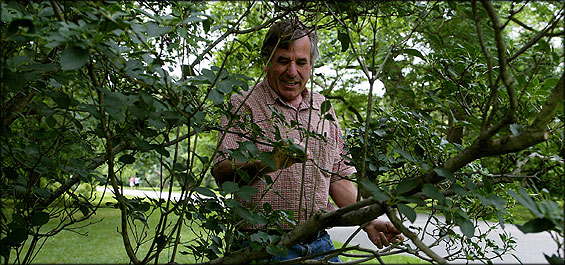
Peter Del Tredici, a research scientist at Arnold Arboretum, said the arboretum's plant collection ‘‘really facilitates scientific research.'' (Globe Staff Photo / Pat Greenhouse)
| Peter Del Tredici, a research scientist at Arnold Arboretum, said the arboretum's plant collection ‘‘really facilitates scientific research.'' (Globe Staff Photo / Pat Greenhouse) |
No need to journey to the Arctic to find evidence of global warming: Venture to Arnold Arboretum, where flowering trees like dogwoods and magnolias have been blooming more than a week earlier than a century ago, according to a new study.
In a paper to be published by the American Journal of Botany this month, researchers document that spring-flowering trees and shrubs bloomed, on average, eight days earlier from 1980 to 2002 than they did from 1900 to 1920. Flowering times were particularly sensitive to small shifts in spring temperatures.
Though the results were probably magnified by the location of the arboretum in Jamaica Plain, Richard B. Primack, professor of biology at Boston University who led the study, predicts the same earlier spring for other, increasingly urbanized areas that generate and retain heat.
''What we're seeing in Boston now -- eight-day earlier flowering -- is exactly what's going to be happening throughout the United States in the next few decades," said Primack.
The research is the latest in a growing body of work to try to link changes in temperature to altered flowering times of plants or migration patterns of birds. The data are not always consistent: A father-son duo reported two years ago in the journal Science that of 500 plant species in Britain tracked over 47 years, nearly 1 in 6 was blooming earlier; others were unfazed or blooming even later. Studies published last year in the journal Nature indicated that warming over the last century was causing animals and plants to move northward and accelerating flowering and egg-hatching in species around the world.
The latest study was unusual in that it tapped historical information housed at the Arnold Arboretum herbarium -- a museum of 80,000 dried, flattened specimens mounted on sheets and labeled to show when they were collected and flowered. Researchers believe it was the first attempt to use plant collections as a measure of past flowering time and ongoing climate change.
''It really demonstrates to people that these collections of plants, which are sort of almost a holdover from a Victorian era, actually do have something to contribute in the modern world," said Peter Del Tredici, a senior research scientist at the arboretum, which is managed by Harvard University. ''We're not just growing these things because they're beautiful, but we curate the collection to a level that really facilitates scientific research."
On the grounds of the arboretum, which has a living collection of 15,000 woody plants, the researchers -- including Primack's son, Daniel, a junior at Boston University, and fellow undergraduate Carolyn Imbres -- recorded the peak flowering times of 229 living plants on the grounds of the arboretum in 2003. The researchers -- who targeted plants with conspicuous flowers that bloom for a short time -- then compared the flowering times for those same trees with their past records, dating back to 1885.
The cool 2003 season -- like this past spring -- brought flowering times similar to those between 1885 and 1920, but was not indicative of a reversal of the warming trend, Primack said.
Flowering plants are some of the most sensitive indicators of climate change because their flower buds open with warming spring temperatures; think of how florists keep flowers in a cooler to prevent premature blooming and prolong their freshness.
Boston has warmed about a cumulative 2.7 degrees Fahrenheit since 1885, about half due to climate change, and half due to urbanization, as paved surfaces and heat-absorbing buildings create an ''urban island" of higher temperatures, Primack said. The city warming probably made the trend toward earlier flowering time more visible than it might have been, but Primack said other growing regions will soon face the same.
Primack and the study's coauthor, Abraham J. Miller-Rushing, are conducting a study funded by the National Science Foundation of plants in Concord -- expanding upon the research done by Henry David Thoreau, the Walden author who also worked as a botanist. Thoreau assembled a collection of hundreds of plant specimens in the 1850s; his work is preserved at the Gray Herbarium at Harvard University.
Stephanie Ebbert can be reached at ebbert@globe.com.